
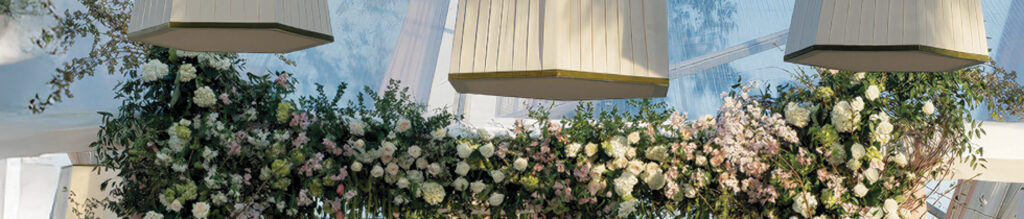
In the world of real estate, the mantra of “curb appeal” is paramount as it tends to set the tone for what’s to come inside the home. In the world of event tents, the entryway or formal “tentrance” of a tent is a similar concept—giving attendees the first and most lasting impression of an event’s aesthetic.
“With traditional venues, you’re working with fixed walls, doors and architectural details that guide the entrance design,” says Liz Cole, owner and creative director of C Creative Group in Mt. Pleasant, S.C. “With tents, the ‘walls’ are temporary and often blank canvases. That gives us freedom, but also responsibility. We’re essentially creating the first impression from scratch. We think of it as framing a moment rather than decorating a doorway.”
Managing transitions
Scale, proportion and flow are key components of any tent entrance. As Cole explains, the entrance needs to feel intentional, not like an afterthought. That might mean adding structure (arches, trellises, pergolas), texture (draping, greenery, florals) and layers of light (uplighting, lanterns, sconces) so the entry feels immersive from the outside in.
“A tent entrance has to manage the transition. Guests are leaving one environment—maybe a parking lot, a field or a driveway—and stepping into an entirely different world,” Cole says. “A good entrance eases that transition, hides the practical side of tenting and sets the tone for the experience that follows.”
When designing a grand entrance for a tented event, Haley Kelly, owner and creative director at Haley Kelly Events in Charleston, S.C., always considers natural elements first—weather patterns, wind direction and the timing of the sunset—all of which impact both comfort and atmosphere.

“From there, budget plays a key role in determining how we can elevate the entrance,” Kelly says. “Just as important is the guest experience: where they arrive, the perspective they have as they approach, and the very first impression they see before stepping inside the tent.”
For Kelly, balancing a client’s vision for the tent with practical considerations always starts with preparation.
“We want their dream design to shine, but we also build in smart contingencies—like side walls, air conditioning or heating—so that the tent can adapt seamlessly to unexpected weather,” she says. “We deliver the experience they envision while still keeping everything realistic and well-executed.”
Growing demand
Fred Tracy, president of Fred’s Tents & Canopies in Waterford, N.Y., says he’s been seeing an uptick in upscale requests for tent entrances. “The structures have become more complex, and the entrances have been right behind them,” Tracy says. “I have done entrances that buses have needed to go underneath from side to side, as well as printed tops and printed tents—from the Sistine Chapel to a full-blown boardwalk. So the combination of color, print and shape has drastically changed definitely over the last five years, possibly 10 years.”
One of the products Fred’s Tents & Canopies offers for entryways are 9-foot glass doors—not the type of product anyone would have imagined installing on a temporary structure just a few years ago.

“When we introduced wood grain and color, it changed the element of the structure from an industrial-looking structure to more of an upscale or elegant-looking tent. By doing that, when we used a traditional door, which was a standard height of 6 feet, 10 inches, I thought it was just too low for such a grand building. So we decided to go to our grand door, or our 9-foot door, and it proportionally looked a lot better and gave it a much bigger opening,” Tracy says. “We’ve made a door as big as 28 feet on one of our customer’s tents for a super grand entrance, and it was an actual fully functioning, working door.”
In addition to wood and glass doors for tent entrances, Fred’s Tents & Canopies has done everything from a pergola with an enclosed marquee for its garden tent to its latest product, the FW Arbor, which is a wood arch crafted of Douglas fir.
“It is such a unique product that when we first started manufacturing it, we were using old gymnasium bleachers from high schools and colleges and repurposing the wood, and using that old vintage wood,” Tracy says. “The product has taken off so well that we had to transition to regular Douglas fir. But using the wooden arch, covered pergola or a half-moon marquee for an entrance can change the element of the tent into a whole different perspective.”
The design process
Today’s clients treat tent entrances more like architecture than decoration. As such, Cole is seeing built facades, custom bars flanking the entrance and asymmetrical floral installations. Even for C Creative Group’s corporate clients, the company is seeing entrances transformed into branded moments that double as photo ops.
“It’s not just a doorway anymore; it’s an activation,” Cole says. Designing the tent entrance comes into play very early in the overall event planning process. Cole typically begins sketching entrances alongside floor plans because placement affects flow, guest arrival and even catering logistics.

“It’s too important to leave until the end. It also usually serves as an anchor piece, so it needs to be planned for with the overall design and budget in mind,” Cole says.
In addition, inspiration for tent entrances comes from the clients themselves as well as social media platforms such as Pinterest and Instagram, which have increased the number of clients with “champagne taste on a beer budget.”
“Our job is to translate those dream ideas into something achievable and unique to their event,” says Cole, who relies heavily on SketchUp for scaled models and renderings as well as Fusion 360 for scaled models that can be translated for her company’s CNC machine to print elements or signage.
When a customer comes to Fred’s Tents & Canopies with a specific vision of a custom project or custom entrance, Tracy and his team work to address these visions.
“We will try to get as close to that design or vision as possible. It’s hard because we need to get that vision onto paper or in a model and say, ‘Is this your vision?’ And then we have to decide how to build it. Do we need to back down on it or can we achieve that vision through ability, engineering, materials and safety?” Tracy says. “So the hardest part is getting that vision from the designer and interpreting that into a model or rendering and getting it as close to their design as possible.”

As tent entrances become more elaborate and thoughtfully designed, a big trend Kelly is seeing is incorporating elements you’d normally find in a home, such as sconces, unique hardware and layered textures. “Wood valences and architectural details add a sense of permanence and polish, transforming the entrance from something temporary into a statement moment that feels both inviting and elevated,” Kelly says.
And while social media has been a tool to help Kelly’s clients visualize possibilities and articulate what excites them, Kelly’s goal is never to replicate something exactly. “We use those ideas as inspiration and then translate them into a design that feels original, personal and true to the client’s vision and budget,” she says.
Embracing challenges
Like any event structure, tent entrances require the juxtaposition of balancing a client’s vision with practical considerations such as inclement weather, venue characteristics and placement and, of course, the overall budget.
Cole and her team start with the client’s “dream” version, then layer in reality. For example, if the client wants sweeping drapery but the venue is windy, they’ll look for weighted hardware or sturdier fabric options. If the budget is tight, they’ll prioritize scale and lighting as those are the elements that carry the most impact.
When budgets are tight, Cole says keeping elements of the tent entrance such as the structure and the lighting is vital. “Those two anchor the experience,” she says. “Decor like florals or signage can scale up or down more easily without
losing the drama. Even with minimal floral, a well-lit, beautifully framed entry still feels impressive.”
The majority of tent events that Fred’s Tents & Canopies handles is during three seasons of the year, so the business is faced with the challenges of wind, rain and sun. To work around these conditions, Tracy has focused on creating larger and stronger products to withstand these elements.

“When we started, the industry standard was 12 gauge and 16 gauge, so the higher the gauge, the thicker the material. Our standard now is 30 and 20 gauge, and I think a lot of people have followed,” Tracy says. “One of the ways we combat environmental conditions is continually developing and working with fabric manufacturers, as well as aluminum extrusions and steel and scaling that appropriately.”
The fabric used within tent entrances also continues to evolve. “If you go back to the early times of tenting, it was the traditional stripe. And then we went to translucent, and then we went to block out fabric, and then were back on the curve of translucent with the sailcloth,” Tracy adds. “You see a lot of introductions of clear and now black and black frame. So there again, color and fabric can change the element of the structure. Trending now is clear and black, and black and translucent.”
A shared vision
Tracy’s advice to others in the industry who may be struggling with delivering innovative tent entrances is “don’t be afraid of what they ask for.”
“If somebody wants it, they normally will have the budget to follow,” he says. “I’ve always said the most important thing is to be aware of what lane you’re playing in. Be careful that the tent or entrance doesn’t take you too far out of your comfort zone but allows you to still achieve the project with the people that you have and the resources that you have.”
Kelly has found that when partnering with tent rental companies to ensure the vision for the tent entrance is achievable, it comes down to experience and communication. “Over the years, we’ve learned the right questions to ask and how to collaborate closely to ensure ideas aren’t just beautiful but also structurally sound,” Kelly says. “A great planner doesn’t stop at the design concept—they understand rigging, weight limits and technical aspects of a tent so the vision can be executed safely.”
When designing tent entrances, C Creative Group also works closely with tent rental companies, treating them as partners by sharing scaled drawings, discussing weight loads and walking through installation challenges together.
“Collaboration ensures the creative vision doesn’t get lost in logistics,” Cole says. “Don’t underestimate the importance of the tent entrance. The guests’ first impression happens here. Investing in the entrance sets the tone for everything that follows. It’s not just a pass-through; it’s part of the story.”
Maura Keller is a freelance writer based in Minneapolis, Minn.





Leave A Comment