

Last year, we were wondering how tariffs would affect the U.S. economy and the domestic portion of the global textile industry, as the rates seemed to change daily at the time the Advanced Textiles Association (ATA) annual industry survey was being conducted in the spring. Inflation thus wound up being at the top of people’s lists of concerns—as it was the year prior—but tariffs being an inflation driver had people worried.
ATA heard throughout 2025 and in comments left on the survey this spring how the overall uncertainty was bad for business because customers can’t put plans in place, forecast demand or even know how much their supplies are going to cost, eroding confidence.
While the survey was open this year in mid-February to early March, the decision came down from the Supreme Court that many of the tariffs imposed in 2025 would need to be refunded. Just before the survey closed, the conflict in Iran began, spiking oil and gas prices and creating shortages in a variety of materials for consumers around the globe. The inflation rate had fallen back to the level of the previous spring, but with the price of oil typically affecting inflation, the consumer price index has started to rise once more.
Amid all the turbulence, one refrain was clear among those we contacted individually for additional input: Resiliency is at the heart of our specialty textiles industry.
“Our industry is influenced by a wide range of global dynamics—trade policy, regulatory developments, logistics capacity, energy prices and broader economic sentiment,” said Marc Shellshear, second vice chairman of the ATA Board of Directors and president of Value Vinyls, in Grand Prairie, Texas. “2025 reinforced how interconnected the global supply chain has become. Changes in one region can ripple across markets very quickly. Looking ahead to 2026, I expect the environment will remain dynamic.”
Adaptability, diversity in markets, good customer and supplier relationships, and planning for the future are keys to success, respondents said—which could apply in any year.
Respondents report on 2025
For the annual survey, ATA solicits opinions from all the readers of all our publications and newsletters and as well as social media followers; it’s not limited to members of the association. Here’s the breakdown of who they are.
About 70% of the companies giving their input this year have fewer than 50 employees, with 25% being run by one to four people. End product fabricators made up 38% of survey takers, and suppliers were 16%. Forty percent of the respondents sell awnings/shade products, 35% covers, 27% fabrics, 26% marine products, 25% each services and bags, 23% enclosures, and 22% each protective textiles and tents.
Company sizes ranged from less than half a million in revenues (21%) in 2025 to more than $10 million (22%). They were predominantly U.S.-focused, with very few of this year’s respondents selling overseas.
Businesses compared their revenues between 2024 and 2025. Just over a quarter reported revenues down, which is less than last year’s 30%. Roughly half of respondents said 2025 revenues were up, and almost 25% reported revenues up more than 10% (see page 9.)
Steven Eisenstein, CEO of Classic Tents & Events of Norcross, Ga., reported that 2025 turned out well regardless of tariffs affecting pricing and wait time for products. “Our regular clients are still actively having new events,” he said. He highlighted some large projects, including the funeral for former President Jimmy Carter. Expectations are high for 2026 too. He highlighted that Classic Tents will be working with other tent companies in 43 states, and he is excited about the worldwide FIFA soccer tournament taking place in the U.S. this summer and their new garden tent.
Perennial top concern: costs
Tariffs in 2025 hit companies differently, depending on how much of their products are made from domestically sourced materials or whether what they purchased is certified as following the rules of origin under the free-trade agreements. No matter what, though, cost increases hit just about everyone.
“Last year, China announced export restrictions on antimony trioxide,” noted ATA chairman Craig Zola. “This is a primary flame-retardant additive used in PVC-based products throughout our industry. Last year, antimony shipments from China dropped 97%, and these shortages have driven antimony prices up 600%-plus. These non-tariff related issues largely remained under the radar of the mainstream media, but our industry certainly felt the impact.”

Notably, almost half of our survey respondents reported their costs have increased by 10-25%, with 8% saying their costs had risen more than 25%. Many noted that vendors had done a good job of warning them in advance of increasing prices, allowing them time to prepare.
One anonymous commenter expressed fatigue and frustration over so many years of cost increases by suppliers. “End manufacturers struggle for their own dollar and the new sale by the time we set pricing.”
In response to the cost increases they faced by suppliers, almost 85% of companies taking this year’s survey had to raise their prices. More than half listed tariffs as another cause of their price increases as well as increased labor costs (62%). (See page 10.) Others put the cause more on inflation/overall operating expenses and freight/shipping than effects from tariffs.
Since the pandemic, Zola noted, “Price management has become a central focus and a top strategic priority for business owners across the ATA membership.”
Looking ahead
The 2026 revenue outlook for our survey respondents seemed optimistic, if that can be inferred from 73% projecting growing revenues. The higher percentage of companies working on government contracts in the mix this year versus last may have something to do with that, or it could be that tariffs didn’t have as large of an impact as expected.
“Our survey respondents remain optimistic concerning 2026 with a majority predicting higher revenues than [the] previous year,” Zola said. “With oil prices on the move, we should continue to keep one eye on input costs and one foot on the innovation gas pedal.”
Classic Tents & Events’ Eisenstein says that one tactic his company has employed is changing the job description of one of its managers, “[turning] her job into a business development role. We went after clients instead of waiting for them to call us,” he said.
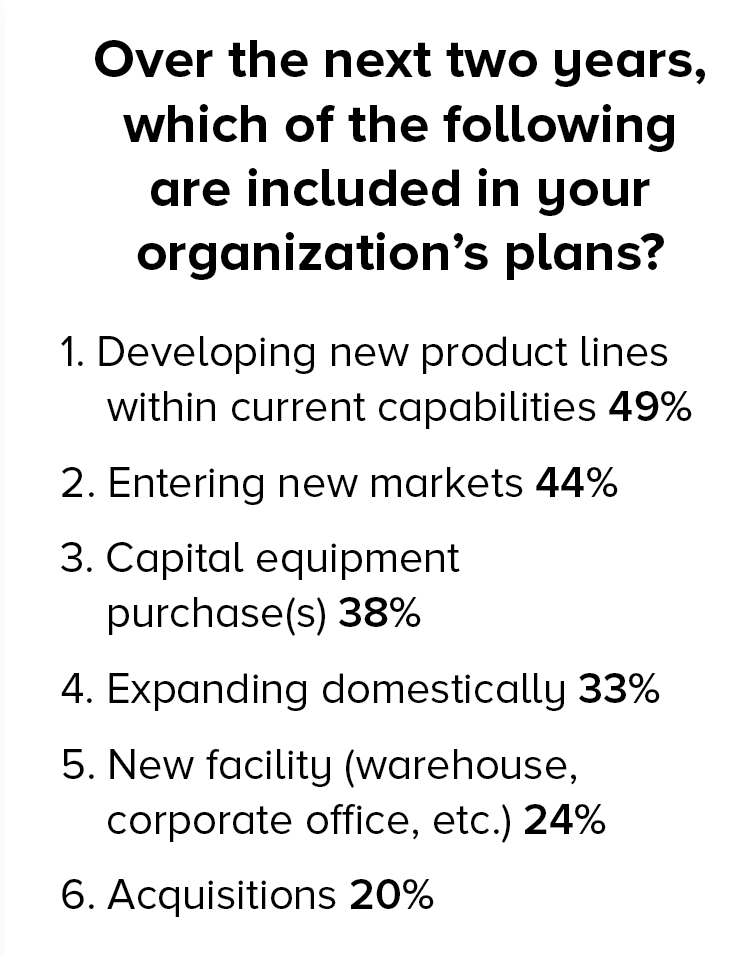
Of highest importance to survey respondents in the next two years are product diversification, research and development, and enhancing their ability to provide personalized products. Nearly half of companies each aim to develop new product lines within existing capabilities and enter new markets, and more than a third will make an equipment purchase. Almost a quarter have a new facility in their sights.
Very few plan to divest, exit markets or reduce product offerings. More plan to acquire a business than to sell one.
“We continue to see opportunities as manufacturers innovate, improve efficiency and explore new product applications,” Shellshear said. “The companies that remain adaptable tend to find opportunities even in uncertain conditions.”
He added, “The companies that succeed will be those that combine strong operational discipline with long-term perspective. Markets will continue to evolve, but organizations that maintain strong relationships and stay focused on serving customers will continue to thrive. For our company, the goal is straightforward: continue being a trusted partner to manufacturers by providing reliable supply, market insight and the flexibility needed to navigate whatever comes next.”
Cathy Jones is the senior editor of Specialty Fabrics Review and she thanks everyone who took the time to fill out this year’s survey. She can be reached at cathy.jones@textiles.org.






Leave A Comment