
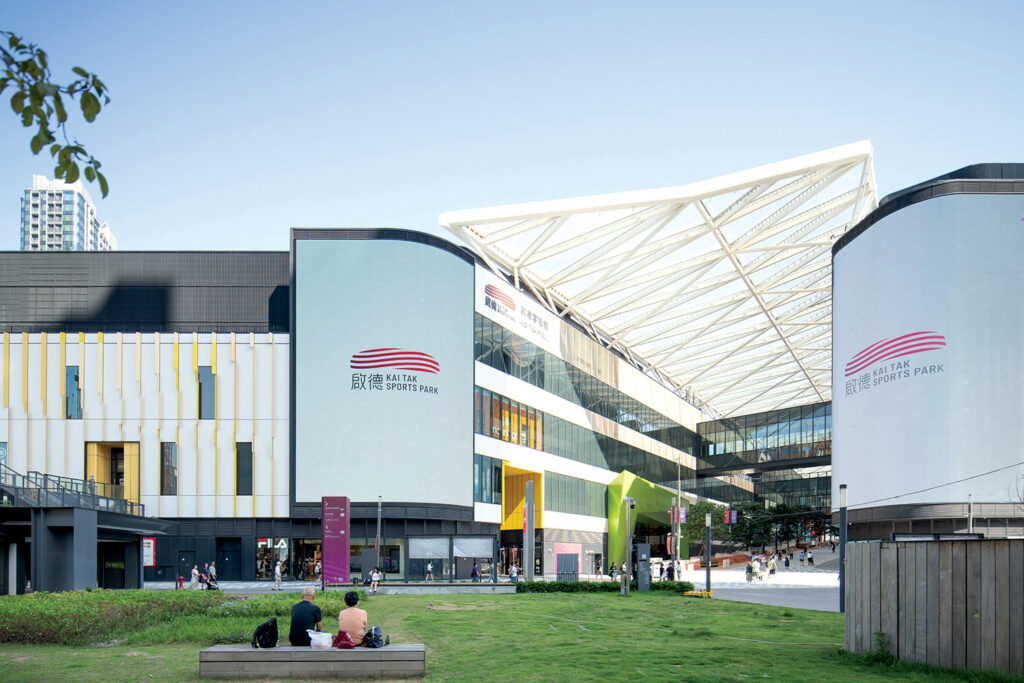
From a distance across Victoria Harbour, the Kai Tak Stadium in Hong Kong looks much like its nickname, “The Pearl of the Orient,” with its color changing with the light, from bluish green to a shiny gray. While sports stadiums have had the same basic shape since the Greeks and the Romans—a circular amphitheater with pitched seats—the Kai Tak Stadium, located in Kai Tak Sports Park, with its acoustically sealed, retractable roof is to the coliseum what a luxury timepiece is to a basic sundial.
This 28-hectare (69-acre) site on the former Kai Tak airport was planned by the Hong Kong government, with a master plan that included several required buildings and sports settings and their locations on the site. The Kai Tak Sports Park includes the 50,000-seat stadium, an indoor arena, a 5,000-seat youth sports ground and a 40-lane bowling alley. Also dictated was a thoroughfare pathway creating a major entryway that directs pedestrians toward the Victoria waterfront as a focal point. The park is intended to engage with the surrounding neighborhood that will eventually house up to 100,000 people in apartments.
“The challenge to this project was ‘How do you get people to invest in sports?’” says James Pearce, senior principal/senior architect with Populous, the lead architect and programming firm.
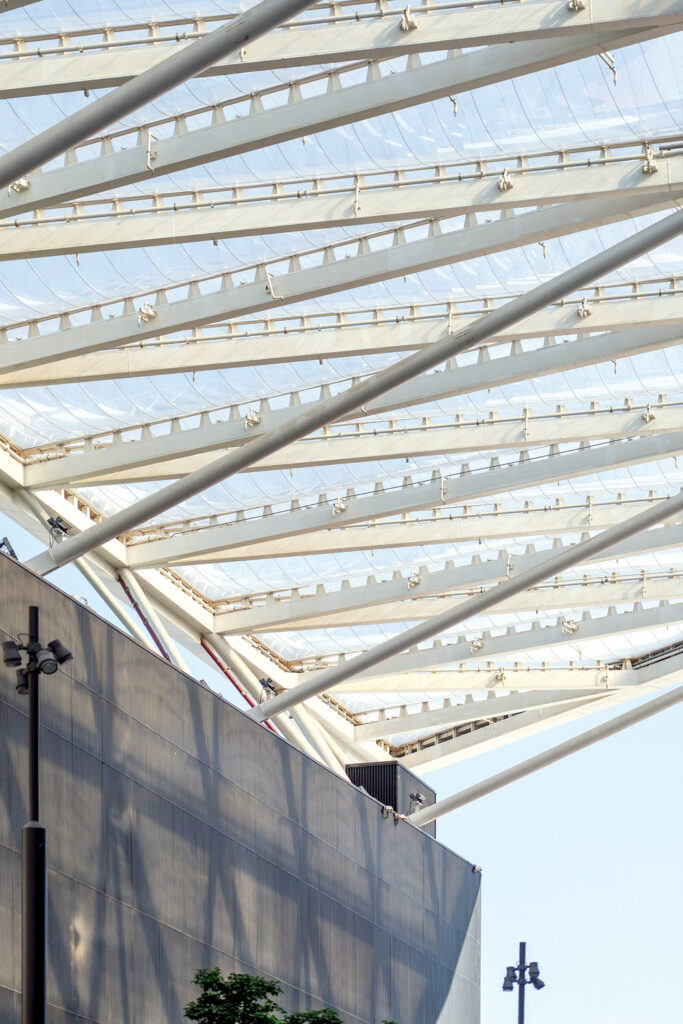
Along the main passageway is a rooftop made with a multilayer ETFE pillow canopy that allows light to fill the passage. Visitors can also find an outdoor rock-climbing wall, a basketball hoop/court and several entries to the indoor sports venues, shops and restaurants, with lots of clear glazing that reveals what’s going on inside.
“We wanted this passage not to feel like an indoor space but to be part of a natural outdoor experience. The canopy material of choice was ETFE for its ability to let in lots of light, enough to allow plants and grass to survive,” says Pearce. “Hong Kong has a challenging environment, and due to high humidity and being in a high typhoon zone, normal greens such as turf, ground plants and greenery do not survive.”
The ETFE pillow system is integrated into a complex cable net structure with stainless steel cable reinforcement, pneumatic inflation systems and high-performance fixings and gaskets. The overall project is designed for high foot traffic and year-round public use.
Project data
Architect: Populous, Brisbane office
Engineer: Maffeis Engineering
Subcontractor [etfe]: Fabritecture
Fabrication: Fabric8 Membrane Services
Fabric: 250 ETFE film pillows with DM4:65 grit pattern from Nowofol
The post Hong Kong athletic victory appeared first on Fabric Architecture Magazine.



Leave A Comment